BLOG

The Cost of an Unemployment Claim is on the Rise!

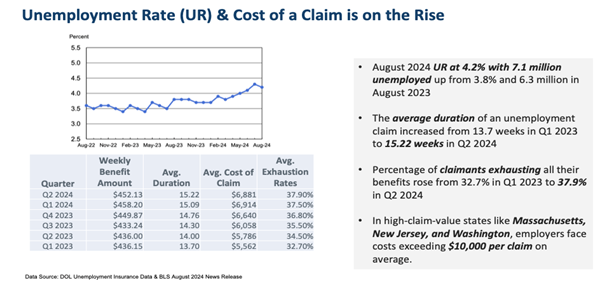
As layoffs increase, so do the financial impacts of unemployment insurance (UI) claims. According to the U.S. Department of Labor, the average cost per UI claim has surged by 23.7% over the last six quarters. The length of claims has also grown, with the average claim lasting 15.22 weeks as of Q2 2024, up from 13.7 weeks in early 2023. Additionally, a growing number of individuals are exhausting their benefits—rising from 32.7% to 37.9% over the same period.

As of September 30, 2024, the unemployment rate showed a slight decline to 4.1%. However, other key indicators remain concerning. The average duration of unemployment claims increased to 15.3 weeks, and the exhaustion rate surpassed 38%, signaling that many individuals are remaining out of work for extended periods.

Unemployment Trends

Key Stats – Q2 2024

  • Average Cost of a Claim: $6,881
  • Average Duration of a Claim: 15.2 weeks
  • Average Savings with Reemployment Programs: $2,064 per claim
  • Exhaustion Rate: 37.9%

The Case for Proactive Claim Management

This upward trend in costs makes proactive unemployment management essential. Leveraging effective reemployment programs can shorten the average claim duration by 30% or more, potentially saving $2,064 per claim.

In states with higher-than-average claim values, like Massachusetts, New Jersey, and Washington, the stakes are even higher. Claims in these regions often exceed $10,000, making a reduction of just a few weeks a significant cost-saver. In such cases, a well-executed reemployment strategy can result in savings of $3,000 or more per claim.

Do you have questions? For further discussion on this topic, please don't hesitate to reach out and schedule some time with us! Let's continue working together toward a more resilient and thriving future.

Proactive Outplacement: A Strategic Investment in People and Brand

In today’s fast-paced business environment, traditional outplacement services often fall short in meeting the real needs of employees during transitions. Rather than focusing solely on managing exits, forward-thinking organizations are adopting proactive reemployment support—a strategy that offers more meaningful assistance to departing employees and creates lasting benefits for the organization.

Personalized Coaching: Empowering Growth in Times of Change

What distinguishes proactive coaching is the personalized guidance it provides throughout the job search journey. This approach helps individuals build the emotional resilience needed to manage the challenges of job loss, ensuring they feel supported through every step of the transition. Beyond emotional support, it also equips employees with market-relevant skills and practical strategies, increasing their employability in today’s dynamic job landscape.

More importantly, proactive coaching fosters confidence and clarity, transforming what could have been a difficult, stressful period into an opportunity for personal and professional growth. With the right tools and support, employees are empowered to approach their next chapter with purpose and optimism.

A Partnership Committed to Success

As a valued customer of NextJob, we want to assure you that we prioritize the needs of each job seeker we work with, delivering personalized support to help them achieve the best possible outcomes. Our proactive coaching model ensures that every individual receives tailored guidance and encouragement at each stage of their job search journey. From building resilience to mastering job market strategies, we stand beside them every step of the way, empowering them to succeed in their next career move.

The Organizational Advantage of Proactive Outplacement

A proactive approach to outplacement isn’t just beneficial for employees—it’s a strategic advantage for businesses. By investing in this level of support, your organization:

  • Boosts morale: Demonstrates care for departing employees, fostering goodwill and maintaining positive relationships during transitions.
  • Strengthens your employer brand: Showcases your commitment to employee well-being, making your organization more appealing to future talent.
  • Minimizes risks: Reduces the chance of legal or reputational issues that can arise from layoffs.
  • Builds loyalty and trust: Positions your organization as one that values people, even in times of change.

A Win-Win for People and Business

By prioritizing individualized coaching and proactive support, your organization sends a powerful message: employees matter—whether they are staying or moving on. This investment ensures that departing staff have the tools to succeed in their next roles, while your company strengthens its position as a compassionate, forward-looking employer.

In the long run, proactive outplacement isn’t just a temporary solution—it’s a strategy that reinforces your organization’s resilience, reputation, and ability to attract top talent. In times of transition, being proactive makes all the difference, turning challenges into opportunities for growth—for your employees and your business.

Do you have questions? For further discussion on this topic, please don't hesitate to reach out or schedule some time with us! Let's continue working together towards a more resilient and thriving future.

Three Ways to Help a Friend Back to Work

Do you know someone who’s stuck as one of the four million long-term unemployed Americans? A family member, a recent graduate, a neighbor, a friend? With long-term unemployment at 42.1% and Labor Force Participation at only 61.6%, most of us know someone. But what can we do?

At NextJob we’ve coached many people struggling to get back in the job market and we’ve learned some important lessons as the Great Recession produced record numbers of long-term unemployed.

What We’ve Learned

First, it appears that getting stuck can happen to just about anyone, regardless of work experience or education.  Job loss is ranked as one of life’s top stressors, alongside divorce and death of a loved one.  It can be hard to recover quickly and can lead to a downward spiral.

Second, reemployment rates drop the longer someone is out of work.  Employers begin to have more questions about employment gaps and job seekers tend to lose their confidence, sapping motivation and the proactive approach that an effective job search demands.

Last, most people can get back to work, but they often need someone in their corner, someone they can trust and talk with weekly about how it’s going.  This accountability factor is critical:  It’s why the job search industry has long agreed that job clubs - regular meetings of job seekers to discuss progress - are one of the most fruitful activities.

Schools, Government & Employers

More than anything, though, we’ve learned that the best strategy is preventing long spells of unemployment through preparation.  Job seekers rate their job search skills at a D+ - not failing, but definitely depressing.  And a sampling of newly-graduated college students rated themselves at an F+ (though the plus seems moot once you’re in the F range).  As a society, we need to be more focused on teaching job search skills in high school and college.  Government benefit programs can also promote proactivity with smarter work search requirements.  And as employers, we can leverage next generation outplacement that can now more than pay for itself in saved unemployment taxes alone.

Three Ways Friends Can Help

Friends and family can also make a big difference using three strategies:

1. Encouragement - Set a time to meet weekly and be a good listener and encourager. Help your friend think through their natural talents, the positive parts of their background and the paid or unpaid accomplishments they’ve had in the past and make sure they have those highlighted in their resume and can speak effectively about them. If they’re depressed, consider discussing professional help.

2. Accountability - Ask your friend what their weekly goals are, and, once they’ve set them, help them stick to the plan each week. Help celebrate every win they have – a new target employer, an updated resume, a network connection, an interview, etc.

3. Connections - Half of all hires are made through a hiring manager’s network. You or someone you know may be the network connection or the encouragement they need: a) to target companies—regardless of whether they have currently posted positions—and b) to start using Facebook, LinkedIn or old fashioned networking to find others who can help get them connected. Proactivity in a job search can increase the likelihood of landing a job by over 60%. If we all work together – schools, government, employers and friends – imagine how many of our unemployed neighbors we can help land on their feet again and reap the benefits and the dignity of a new job.

Free NextJob Services

To support your efforts, for a limited time, we are offering your family and friends access to our online job search training system for free.  They can simply go to www.nextjobtraining.com and use the access code “NextJobCovid19” to access resources that will help them set goals, create a resume that gets noticed, target employers, prepare to interview well and much more. As part of our close network this gift is free from NextJob for your family and friends.

For more insights, visit us at  www.nextjob.com.

Get Ready for Your Next Job Interview

Interviews can be stressful – but if you prepare well, they can be enjoyable. And when you prepare thoroughly for an interview, you'll show the hiring manager that you'll go the extra mile if you're hired for the job.

Use these three tips to make the best impression at your next job interview:

Research the employer – Learn why the company may be a good fit for you before the interview. Use the employer's website and internet searches to learn about the company, its history, locations, products and services. Look for recent company press releases and news articles.

Research your interviewer – Interviewers are more likely to hire someone who has something in common with them. Learn everything you can about the interviewer including their background, interests and mutual connections you may have. Use the power of LinkedIn, Facebook, Twitter and other networks to ask people in your network if they have any connections to the interviewer.

Practice your opening and close – People tend to remember the beginning and the end of a conversation. Practice what you’ll say at the start and end of your interview – in the mirror, with a friend or with a job coach – so those parts will go smoothly.

The Rule of Three's

Most job seekers aren't sure how to follow up after an interview or submitting an application - not knowing when an employer will call or when to follow up if they don't. Don't miss this important step. Employers often watch how you work on your job search to assess how you’ll work in the job.

Follow these keys to effective follow up:

Follow the "Rule of Three's"– In the first 5 to 7 days after submitting your resume or application, follow up by phone or in person and express interest in the position. If you don’t receive a response within two weeks, try again by email or send a message through LinkedIn. If you still haven’t received a response after a month, consider sending a handwritten note. Continue following up every few weeks to touch base on the progress of the search until the position is filled.

Make the extra effort– Always follow up with a thank you note within 24 hours of any interview. Send an email as well as a handwritten thank you card. The extra effort and the sincere appreciation for their time will speak volumes as to what kind of employee and coworker you will be. Be sure to also let them know you are interested in going to the next step!

Be persistent– Don't get discouraged. If you don't receive a response, don't stop making phone calls. Even if it's uncomfortable, remember to be confident. If you've done your research, the employers you've picked will be lucky to have you. Even if they've chosen another applicant, you may get a job lead for another position with the company by demonstrating your interest and professionalism.

3 Key Job Interview Questions

untitled

Many people go through an interview and don’t ask a single question. They are scared or assume that the hiring manager is the only one allowed to lead the conversation. In reality, interviewers appreciate job seekers who know what they are looking for and demonstrate their interest in the position. When you ask great questions you’ll also uncover the priorities and responsibilities of the job so you can effectively sell your experiences and accomplishments back to the employer.

Three key questions you should consider asking in an interview are:

  1. Company Challenges – Ask: “What are some of the key challenges the company is facing right now?” You’ll demonstrate that you’re thinking not only about your own position, but also the well-being of the company. Employers love team players who think about the bigger picture.
  2. Keys to Success – Ask: “What abilities are the most important for success in this position?” This question will show that you are focused on succeeding and you’ll be able prioritize your answers based on what the interviewer tell you is important.
  3. Personal Approach – Ask: “What do you most enjoy about your work here?” You’ll show that you have a genuine interest in your interviewer as well as an interest in enjoying your work. This will demonstrate that the job is not just a paycheck for you.

Asking the right questions gives the interviewer a chance to talk while educating you on what you need to know about the job.

Helping you land your next great job...faster.

Employers can subscribe to our Reemployment Industry Insights mailing list and job seekers can subscribe to our Job Search News & Tips mailing list.

3 Tips to Tap the Power of the Informational Interview – A Priceless Lunch

Networking can be hard, but one great trick you can use is the "informational interview." Simply find someone who works in a company or a job you're targeting and ask for a conversation to learn more. To save them time and make it casual, ask them to meet for coffee or lunch. You'll normally learn more about a target company or occupation over lunch than you might in months of researching, and you'll often discover job openings and gain connections you'd otherwise miss.

informational-interview

Use these three tips to start tapping the power of an informational interview:

  • Use your employer target list – Look for hiring managers or people in your network who work at a target employer by searching for the company on LinkedIn or Google. Narrow your search to your local area, so you can meet in person. If you don't find anyone that way, ask the receptionist to connect you to someone from the department you're targeting.
  • Make contact – Be personal and sincere -- do not use the default generic messaging options if you are using LinkedIn. Simply ask this question: "I'm really interested in your work and your company. Would you be willing to have a conversation with me over lunch or coffee about your job and how you started in your career?"
  • Ask great questions – Most people are flattered that you would want to know about their life and even more flattered that you might want to be like them. When you meet, ask personal questions such as, why they chose their job, what they like about their current company, and recommendations they have for you to gain experience in their field. Always close by asking if they are aware of any opportunities in their current company or anyone else they'd recommend you talk with next.

Use these tips and you may just find that you’ve taken a big step toward finding your next job.

Employers can subscribe to our Reemployment Industry Insights mailing list and job seekers can subscribe to our Job Search News & Tips mailing list.

4 Key Roles of a Good Job Coach

compass-283234_640

Over half of college graduates are unemployed six months after graduation and 39% of Unemployment Insurance claimants are considered long-term unemployed having been out of work for more than six months.

Research shows that job seekers receiving the right kind of help can increase their chances of landing a job by six times. What is the right kind of help? Broadly, the right help—according to the research—is teaching a variety of job search skills, providing motivation and encouraging proactivity. In the outplacement world, this can be provided using the right combination of the latest technology and a job coach.

I use the word coach, because a good coach helps people strengthen and sharpen their skills, in this case, job search skills. They fill the job search tool box with important stuff: advice, instructions, motivation, inspiration and direction.

A job coach can be many things to many people, but a good job coach will play the following key roles as part of the team that will help a job seeker land their next job.

  1. Mentor

A good job coach won’t just tell a job seeker how to do something. Instead, they explain why certain processes and actions in their profession are necessary and beneficial to the job seeker’s success. The coach will help identify and provide advice and direction on how best to target professional opportunities. They will also help develop strategies for improving performance in particular areas. This approach helps the job seeker understand not just how to do something, but why they need to do it.

  1. Motivator

For a job seeker to be successful in their job search they need to be motivated about their work history, career direction, skills and ability to move forward. A good job coach will help them identify what they are doing well and assist them in capitalizing on their strengths. At the same time, the coach will point out their weaknesses, or areas in which they need improvement, and help them develop an approach to bettering themselves. The coach needs to build an honest, trusting relationship with each and every job seeker they serve in order to help each job seeker achieve their goals.

  1. Goal-Setter

A good job coach helps chart the course of the job search through goal setting. They help set agendas, develop timetables, plan for the job search, and help the job seeker stay focused and on-track. In addition to meeting with the job seeker on a regular basis to assess progress, the coach will be available on an “as-needed” basis to help evaluate opportunities, plan for interviews and develop networking strategies.

  1. Confidence Builder

A good job coach will recognize and celebrate positive strides and remind the job seeker of the progress they’re making. They will help identify and highlight a job seeker’s strengths in a way that builds confidence.

Everyone has had a great coach in their past. It may have been a parent at home, a sports coach in school, a manager at a summer job who pushed them a bit or a mentor who took them under their wing. These were all coaches in their lives.

A good job coach can help each job seeker learn a critical life skill – job search.

For a limited time, job seekers can visit us at https://nextjobcom.webflow.io/nextjob-scholarships-recent-grads for free access to our jobseekers toolkit where they can create their own job search plan.

5 Critical Job Search Networking Truths

networking

Half of all job openings are “hidden”; that is, they’re not listed anywhere. Instead, they’re filled through networking, word-of-mouth and direct contact with job seekers. This is why building your brand online and putting it to work for you can mean the difference between finding a job and finding your “dream” job.

You’ve heard it said, “It’s not always what you know, it’s who you know.” It’s also who you can get to know. There is truth in these statements, especially in finding your next job, and there are some good reasons for it.

It’s the same reason employers ask for professional references. Hiring managers want to know who you are, who you know, and that you share their core values.

If you know someone in their network, it's as if you have already had an initial interview. The hiring manager can rely on your network contact's recommendation to go to the next step.

Fortunately, your network may be even bigger than you think and it’s important to connect with the right people, in the right way, so they can connect you with the right jobs.

Here are the 5 critical truths to networking your way to your next job:

  1. Don’t be antisocial: Use all of your networks, both personal and online social networks whenever possible. LinkedIn is especially important for establishing and nurturing business relationships.
  2. Be a job-stalker: Evaluate what you want in an employer, what you value, and the best cultural fit for you and follow companies that interest you. Connect with their recruiters, key players, associates and company websites.
  3. Rub some elbows: Seek out professional opportunities to meet these key players in person whether through mutual connections or local industry events.
  4. It’s who you know: Don’t be afraid to ask existing contacts for introductions to make new contacts. You never know where a new connection will lead. Try out asking insiders for time to share their experiences in an informational interview but don’t be pushy – keep it informational.
  5. Make it snappy: Develop and refine the elevator pitch for your personal brand and build your own personal commercial.

For a limited time, job seekers can visit us at https://nextjobcom.webflow.io/nextjob-scholarships-recent-grads for free access to our jobseekers toolkit where they can create their own job search plan.

The “Real” Income Issue Lurking Behind Student Debt and the “Pay As You Earn” Program

20121118-student-debt

This past month, the Department of Education proposed expanded eligibility rules for its Pay As You Earn (PAYE) program which is designed to help relieve the debt burden for close to six million students.

The program basically does two things. First, it gives some students the opportunity to have their remaining student debt forgiven after 20 years. Second, it allows student loan payments to be adjusted to better match a borrower’s discretionary income.

The proposed changes are getting mixed reviews with lots of analysis. What’s mostly missing though is a more rigorous focus on the “real” discretionary income issue.

While overall unemployment rates have come down to a seven year low of 5.3% at the end of June 2015 most know that there is much more to the story. Among the most alarming is that for recent college graduates, the statistics have been pretty bleak, with only 52% employed full time 6 months after graduation.[1] Compounding the problem is the fact that 49% of 2013 and 2014 graduates consider themselves underemployed or in a job that does not require a college degree.[2] These are the real income issues in our student debt problem.

At a time when graduates are struggling to find meaningful and lucrative work using their hard earned education, they are also struggling with large student loan balances hanging over their heads. When a student stays unemployed for their first 9 months after graduating, their lost wage opportunity is an average of $33,000,[3] equal to an average graduate’s entire college debt.[4] But what students appear to be more immediately worried about is will they find work that matches their schooling or their passions.

This really hit home for me when, five days before her graduation, I received a frantic call from my niece. Instead of relishing the joy and excitement of finally achieving her goal of graduating from college, she was in tears. She had worked so hard, but was without a job - at least not one that counted. Continuing to work at the local sub shop did not count for her.

Final exams were behind her and the uncertainty of what came next was overwhelming - where she was going to live, how she would learn to effectively look for a job and whether she would be able to land work in her chosen field. Not once did she mention her student loans, which are significant. She did mention that there were no classes on campus on job search and she and most of her classmates had little understanding of what a career center could or would be able to do to help.

Job search is hard - a job all on its own. The job market is tough, but, with more than 50 million hires a year and employers talking talent shortage, jobs are out there. The key is to equip our students with what should be considered a basic life skill – job search readiness. Researching the job market, networking appropriately with confidence, building a personal brand, crafting an accomplishments-based resume, developing the poise and clarity of thought to handle tough interview questions – these are critical skills that will shape a student’s path through an average of 13 jobs in a career and determine the fit and fruitfulness of the bulk of their weekday activities the rest of their working lives.

Adjusting student loan payments may help alleviate some pain, – let’s face it, a lot of pain – but the root cause of the problem and moment of truth for our students as they embark on this next phase of their lives is how they will learn to choose a career path and gain the skills it takes to land a job that’s right for them.

My niece was one of the lucky ones. This fall, she’ll be a music teacher in a school she loves and has signed the lease on her first apartment as a college graduate. She worked hard at her job search and she had job search help. In the process, she developed a critical life skill. Her question to me: “Why don’t they teach this stuff in school???”

For a limited time, job seekers can visit us at https://nextjobcom.webflow.io/nextjob-scholarships-recent-grads for free access to our jobseekers toolkit where they can create their own job search plan.

[1] https://www.accenture.com/us-en/insight-2015-accenture-college-graduate-employment-research.aspx

[2] https://www.accenture.com/us-en/insight-2015-accenture-college-graduate-employment-research.aspx

[3] https://www.naceweb.org/s04022014/starting-salary-class-2014.aspx

[4] http://college.usatoday.com/2014/08/26/how-much-student-loan-debt-is-too-much-2/

* To learn more, employers are invited to subscribe to our Reemployment Industry Insights mailing list and job seekers are welcome to subscribe to our Job Search News & Tips mailing list.