.png)
The Employee Engagement Perception Gap & Why Outplacement Matters More Than Ever
Employers believe engagement is improving.
Employees aren’t experiencing it the same way.
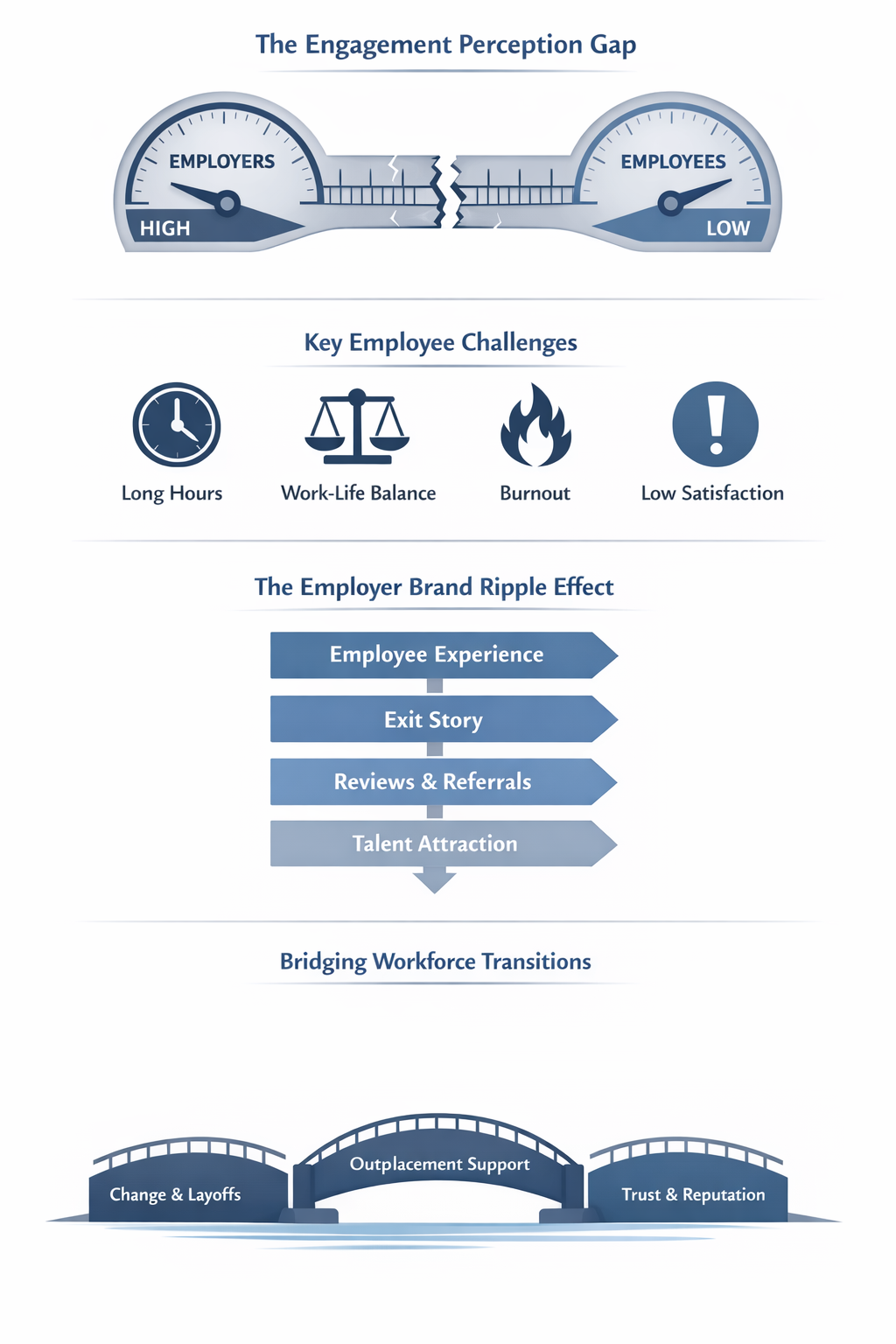
Recent findings from the TriNet State of the Workplace 2025 report highlight a growing perception gap between how employers view employee engagement and how employees actually experience work.
While leaders often report stable or rising engagement, many employees, particularly Millennials and Gen Z, describe longer hours, reduced work-life balance, and increasing burnout.
This disconnect doesn’t just affect retention. It has meaningful implications for employer brand, trust, and talent attraction.
Understanding the Employee Engagement Perception Gap
TriNet’s research points to a consistent pattern across organizations:
- Employers rate engagement and satisfaction higher than employees do
- Employees report increased workload and pressure, even when productivity appears strong
- Burnout often goes underrecognized until it results in disengagement or turnover
This isn’t a failure of intent. Most organizations genuinely want to create positive employee experiences.
But employee experience is shaped by perception, not intention, and perception is what employees carry forward when they leave.
How the Engagement Gap Becomes an Employer Brand Risk
When employer perception and employee experience don’t align, the impact extends beyond internal engagement scores.
The engagement perception gap influences:
- Who applies for open roles
- Who accepts job offers
- How former employees describe the organization
- What future candidates see and hear about your workplace
Employer brand is shaped long before Day 1 and reinforced long after employment ends.
That makes moments of change especially consequential.
Engagement Doesn’t End When Employment Does
One of the most overlooked truths in workforce strategy is that employees continue forming opinions about their employer after they leave.
For many individuals, how they are treated during a transition, whether due to layoffs, restructuring, or role changes, becomes the most memorable part of their experience.
This is where outplacement services play a critical role.
When employers provide structured, human-centered support during transitions, they:
- Reduce uncertainty and anxiety for departing employees
- Preserve trust with remaining team members
- Protect employer reputation during highly visible moments
Outplacement is not just a benefit for individuals, it is a strategic lever for employers navigating change.
How Outplacement Services Support Employer Brand
Outplacement is often viewed narrowly as a post-layoff service. In reality, effective outplacement services help organizations bridge the gap between employer intent and employee experience.
When done well, outplacement can:
- Reinforce dignity and respect during difficult transitions
- Reduce reputational risk following workforce changes
- Support talent attraction by demonstrating values in action
- Strengthen long-term trust with employees, alumni, and candidates
These moments matter because they shape the story employees tell, not just today, but years later.
The Opportunity Inside the Engagement Perception Gap
The employee engagement perception gap isn’t only a warning sign. It’s also an opportunity.
Organizations that acknowledge and address the difference between leadership perception and employee experience are better positioned to:
- Strengthen employer brand credibility
- Maintain trust during periods of change
- Support future hiring and rehire pipelines
- Reduce long-term talent and reputation costs
Closing the gap doesn’t require perfect engagement metrics. It requires awareness, empathy, and intentional support, often delivered through outplacement services, when change is unavoidable.
Employer Brand Is Built in the Hard Moments
Employee engagement today isn’t just about how work feels day to day.
It’s about how people remember being treated when circumstances change.
In a transparent labor market, those experiences travel fast, shaping trust, reputation, and future talent decisions.
Source
TriNet State of the Workplace 2025
About NextJob
NextJob provides outplacement services that help organizations support employees through moments of transition, protecting employer brand while helping people move forward with clarity and confidence.
Because how you handle change shapes how your organization is remembered.
If you’d like to explore how outplacement support can reduce UI costs, protect your brand, and strengthen culture during transitions, contact us at https://www.nextjob.com/contact.